
Who’s Afraid of Frankenstein on Włókiennicza Street?
Although our project W20 (on Włókiennicza) is local, with a scale of only one street, we decided to plant it on a massive foundation just in case. Perhaps we were a little overly optimistic that the role of such a foundation can be played by the belief in human rationality. It took Europe a lot of time to investigate Reason, but the experience of the 20th century taught us Europeans reason enough to finally recognize that all the problems that divide us can be solved by talking. The only sense of the world available to homo sapiens always appears in conversation, in dialogue with others. Community, talking to each other Community is the source of Reason. The meaning of the existence of cities and life in the city is to live in a way that gives you the opportunity to meet others often. The intention of our city Think Tank - Talk and Lodz Is the beginning of the construction process on Włókiennicza Tenement Houses Conversations. The main function will simply be to promote conversations, the meaning of which will not be the exchange of services, goods and even information, but dialogue with which elementary interpersonal solidarity begins.
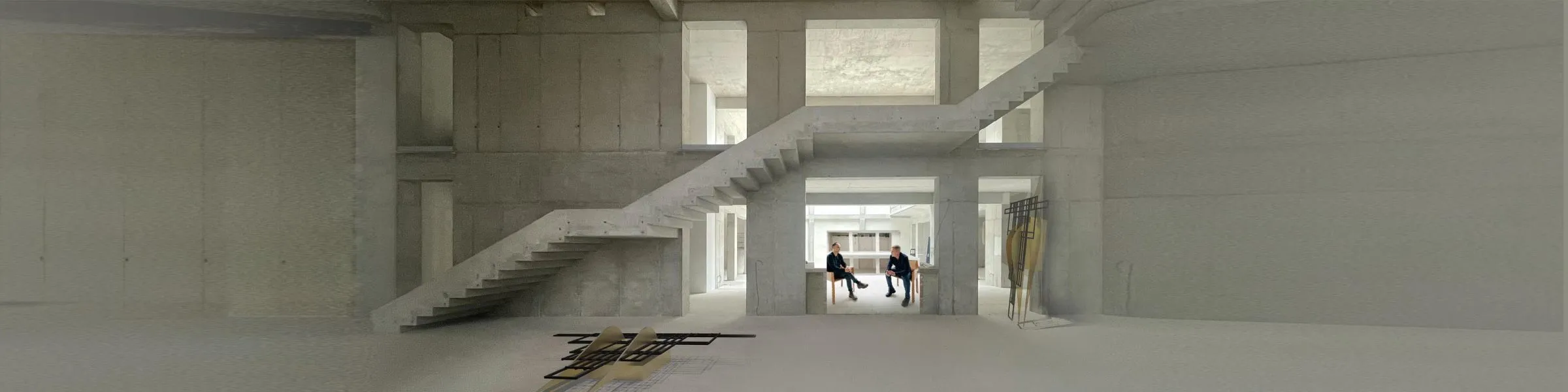
In a sense, following the thought of Hans-Georg Gadamer, who drew attention to the primitiveness of conversation with reason, we return to mythical beginnings. To the polis and Greek dialogues that shape the polis from the inside. So our project is more or less equally split between architecture and anthropology. At the same time, architecture has a servile role as a supporting medium, encouraging meeting and conversation. The essence of our project cannot be shown in any brilliant visualization. She is not visual at all. It is not spectacular, but related to the concept of methanoi - a deep, personality-encompassing transformation that any homo sapiens can experience, most often after meeting another. From the point of view of anthropology, this project can be called an attempt to implement what is traditionally referred to as a philosophy of dialogue (from Martian Buber, Emanuel Levinas, Franz Rosenzweig, Józef Tischner) only that using architectural means.
Why is it worth cheering for us in this attempt to rebuild a community in a place that is quite exotic for most of us. We will repeat the thought once expressed by the Ukrainian poet and writer Yuri Andrukhovych, who noted that "a writer coming to the West from Central or Eastern Europe finds a literary perfect situation there: he can tell uncreated stories about his city, country, about his part of the continent, he can spin the most fantastic stories and give them as the truest truth, and then he can calmly go to rest, because his stories will never be verified. Partly because the audience suspects that anything can actually happen on these pages, partly because the existence of these sites for the audience is extremely problematic and resembles literary fiction" (A. Stasiuk, Fado, p. 84)
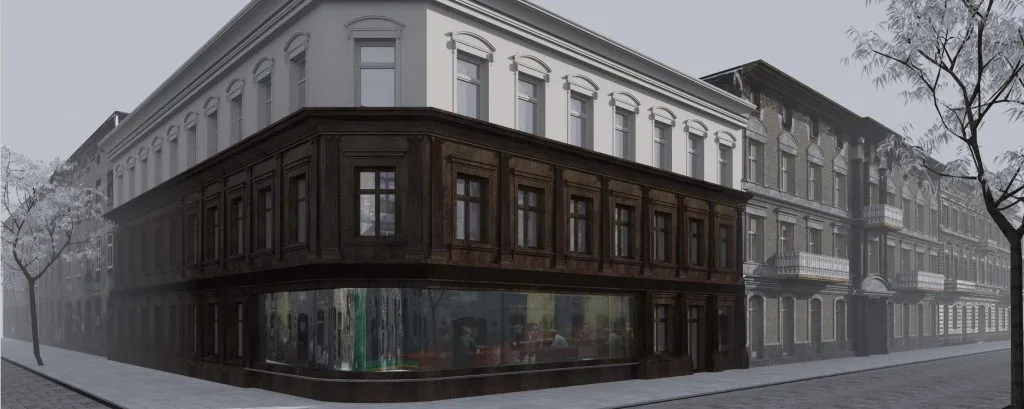
Włókiennicza has aspirations in its environment to focus very different functions - most likely it will be the seat of different institutions and people, in a word, contrary to the appearance of its uniformly shiny, renovated facades, it will be (and should be) a hotbed of diversity. Therefore, at the design stage, it is worth determining not necessarily one correct, but several basic value scales that could serve as a reference point for many designers working on this project. This should help to avoid the Frankenstein effect - the creation of a monster sewn from differently scaled and differently developed parts, which apart from the ardent desire of the creators have nothing in common. It is admittedly a very spectacular effect, but in the city Łódź it occurs in excess and it is not worth repeating it again.