
Jarosław Kozłowski’s Devices and the Devising of Art
Szymon Wróbel
All my life politics has made my blood boil. I conclude from this that the only Father I knew (the one I chose) was the political Father.
Roland Barthes1
Art does not exist without the gaze that sees art in it.
Jacques Rancière2
a) By bypassing institutions, the artist may develop the stance of a clerc.
b) By bracketing them and incorporating them into his actions […] the artist is able to make structural use of the social anonymity and objectivity of institutions […].
Andrzej Kostołowski3
Politics
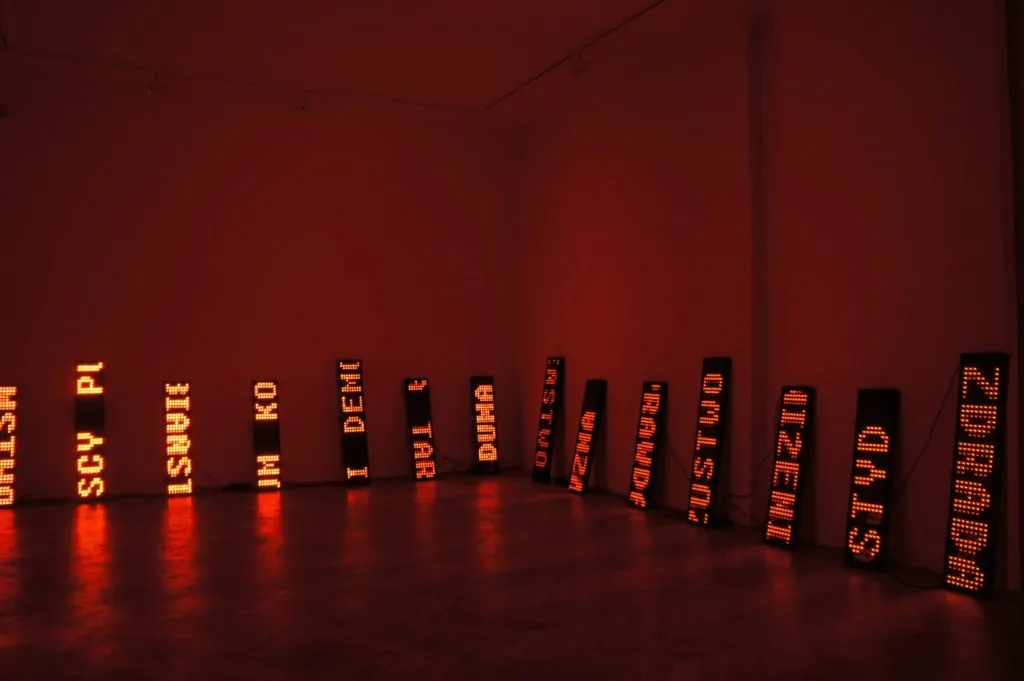
Jarosław Kozłowski’s presence in politics appears ambivalent, and the tension he creates between politics and aesthetics exceeds every relation of subordination—whether of aesthetics to politics or politics to aesthetics. Jarosław Kozłowski does not fit within politics, but nor does Jarosław Kozłowski fit within aesthetics. Let us begin with the fact that Jarosław Kozłowski wishes to delimit politics, just as he wishes to delimit aesthetics. In a sense he wants to avoid the fate of the political subject, but also the weight (or lightness) of the banal aesthetic object. This does not mean, however, that Kozłowski wishes to expand aesthetics or politics territorially, structurally or ideologically, or that he seeks to fuse (alloy) one with the other into something resembling an aesthetic-political amalgam. What connects politics and aesthetics in Kozłowski’s incorruptible gaze is the fact that, in each domain, its objects (subjects) are on a stage—a stage of struggles for domination (the votes of the electorate), or perhaps recognition, or a stage of seduction, that is, struggles for the attention (and wallet) of the bored viewer/passer-by. This inevitable hystericisation and affective agitation of aesthetic objects, but also political objects, which follows from stepping onto the stage of the spectacle, produces irritation and despondency in Kozłowski. The viewer’s excitement at the spectacle of politics, but also at the spectacle of aesthetics, makes them a bad subject of politics and a bad subject of aesthetics. In a sense, Kozłowski’s exhibition entitled Everything Buzzes Except When It Gurgles. Exercises in Declension, as well as the exhibitions Non-Truths/Non-Lies and Recycled News 2, address this bad subject of politics and resistance to aesthetics at the same time.
The buzzing and gurgling of media chatter in Jarosław Kozłowski’s project is translated into the soundless movement (flowing, undulating) of word-images across illuminated displays. Yet this is not a simple quotation from reality, a mockery of the media. Nor is it merely that the electronic transmission of texts, as in public-information systems, reproduces clichés contained in a language that has long been dead. Words and phrases drawn from public discourses, removed from context and ceaselessly moving before corruptible eyes certainly reveal the persuasive rhetoric of media language: buzzing and gurgling. For buzzing and gurgling have become the natural melody (speech) of the world, a kind of background music: ambient. When sounds from our surroundings hover at the threshold of audibility, we realise that music can be treated as an element of those surroundings, just like the colour of light and the sound of rain. The (un)natural music of our world is the ceaseless flow of information, which induces a state of endless stupefaction. In successive versions of Rhetorical Figures, Kozłowski returns to the emptiness (flow and undulation) of public discourse (ambient music), and perhaps to the exhaustion of language itself. An expanding structure of cardboard boxes covered with newspapers painted black acquires meaning when juxtaposed with an electronic display transmitting the words: No news from…, repeated together with the names of twenty-three cities around the world. Information no longer serves to inform, just as in Kozłowski’s earlier devices—the Libraries of 1993 and Reading Rooms of 1994—books are no longer for reading, but become solids or, as we shall shortly say, (counter-)devices with their pages glued together and painted over, impossible to read.
The category of “appropriation” or “hijacking” [détournement], also known as la perruque and developed by the French Situationists, principally Guy Debord, may prove useful in understanding Jarosław Kozłowski’s projects. In a manner akin to satirical parody, the procedure of appropriation attempts to use old, culturally and historically given material, as though putting it to work on a new task. “Appropriation” [détournement] is thus the work of reclaiming objects for unknown (and not necessarily original) purposes: objects appropriated by the media, the market, parapolitics and monetary exchange—an appropriation experienced today in the form of the universal compulsion to communicate4. In his art of appropriation, Kozłowski may resemble a worker accused by the law of theft and of using someone else’s machinery for his own ends, a member of the precariat who uses materials for innovative, non-productive purposes. Applying this technique leads directly towards an encomium to poaching, subterfuge, jokes and roguery; to the art of setting tricks in motion, the art of improvising and of reversing the balance of power so as to make the weaker argument stronger; to the art of ambush; and, finally, to an invitation to take endless joy in inventing the everyday and refusing to grant the present order the status of law.

Kozłowski calls these arts, these tricks, Fluxus arts. What is Fluxus? Well, on the fiftieth anniversary of the first Fluxus festival and the thirty-fifth anniversary of the only Polish festival, held at Galeria Akumulatory 2 in Poznań in 1977, Kozłowski recalled the experience as follows: “Fluxus is an artistic movement founded at the turn of the 1950s and 1960s, bringing together artists from different countries (musicians, performers, poets and visual artists) and drawing upon the Dada tradition, the work of Marcel Duchamp and the radical ideas of John Cage. Its initiator and founder was George Maciunas, an American artist of Lithuanian descent. It was he who devised the name fluxus (to flow)—initially intended as the title of a planned journal that never appeared, and later used to describe the entire artistic movement, which embraced constant mutability and a programmatic evasion of all canons and conventions. This also applied to the traditionally sanctioned boundary between art and everyday life, and between artist and viewer. […] Fluxus was, and remains to this day, a manifestation of freedom, an anarchic stance towards official art and present-day reality. Its preferred means of challenging social and cultural stereotypes are jokes, laughter, paradox, irony and provocation”5. Kozłowski does not mention the Situationists—Raoul Vaneigem or Guy Ernest Debord—but it is clear how close the Situationist arts of overturning life must have been to Fluxus. The art of walking through the city as the art of wandering; the art of using language as the art of poaching from books and reciting old tropes in ever-new places; and, finally, the art of practising beliefs in opposition to the “political beliefs” handed to us like consumer goods—the art, that is, of profaning the theatre of façade-like advertisements and the promises of politicians who appropriate the old theological techniques of former demagogues: these are the domains, areas and territories in which the game for the birth, perhaps even the establishment, of a new Fluxus life is played.
After this recollection of the past, I return to the question: what is Jarosław Kozłowski’s fundamental problem with politics and aesthetics? In politics and aesthetics one may be either an object or a subject; there is no other choice; one cannot be neither, or both at once. Kozłowski says: this kind of politics and this kind of aesthetics must be changed; we must change a politics and aesthetics made up of excited subjects (objects) in the audience and exciting objects (subjects) on the stage. Kozłowski’s place, his alternative stage of politics and aesthetics, is language, grammar and, in fact, a rhetoric of deterritorialisation—a rhetoric of “appropriating” and “hijacking” [détournement] language itself. Kozłowski wants to be a subject, but not a political speaker, an orator in the manner of Cicero, with whom political discourse—that is, the presence of politics in the word—began. In De oratore (On the Orator)6, Cicero becomes the subject of political discourse, becomes the speaker: the one who simultaneously creates a political narrative, informs the viewer of its content and puts his name to it (identifies with it). Kozłowski wishes to create a politics founded upon the abduction and appropriation of Cicero’s speech.

The logic of “appropriation” or “hijacking” [détournement] does not exhaust Kozłowski’s actions (inventions). Jarosław Kozłowski is excluded from his own discourse (action), and through that exclusion he is able to give meaning to what he creates—to become an incorruptible eye. Kozłowski behaves as though he were a historical witness (an eye for a new, different stage) to the contradiction of his time: the existence of a politically divided subject who feels and speaks, and a subject who feels and remains silent. Crucially—in the view of the author of Non-Truths/Non-Lies—these two subjects cannot be kept apart. The paradox of Kozłowski’s situation lies in his occupying both subject positions at the very same moment: he speaks and remains silent; he creates images and records them. The bridge between these two positions—speech and silence, the production and recording of images—is sensitivity: sensing, but not a sense, a feeling or, still less, a sense of well-being; perhaps, at most, compassion. I do not know whether Kozłowski seeks to create a community of fellow feeling, but he certainly seeks to sensitise us to the extraordinary, incomprehensible and ethically consequential fate of images, and to the politically consequential and incomprehensible space of looking together.

I therefore ask once again: what gives rise to Kozłowski’s resistance to politics? Politics is a sphere in which discourse repeats itself, becomes ritualised and trivialised, and exhausts itself in this ritualisation. Repetition and ritualisation are defining indicators of political language. Politics in language is simply a procession of immobile sentences, perhaps even isolated expressions, signs, ornaments, signals and word-images that, at the moment of political choice (a political state of exception), attempt to rise to the level of excitement. It is pathetic, Kozłowski says. Despite Cicero’s prodigious efforts, politics degenerates into chatter, loquacity, speech at war with itself. Special conditions are needed if politics is not to lapse into repetition and trivialisation: politics must establish a new kind of discursivity. What does this mean in practice? Well, it means that a political (rhetorical) subject of the order of Marx or Brecht must create a language at once rigorous and free, marked by aesthetic singularity, as though reinventing both the world and what has already been said. In such a language, a new, different stage appears as a place in which reality is instituted. Kozłowski must surely have asked himself: is this still possible? Is it possible at all? Is it possible to establish a new stage of looking? Is it not possible? Then it is attainable. In accordance with the Fluxus logic of la perruque, our desire is directed towards the impossible and towards liberation from what is not necessary. The real must become impossible!
I ask once again: what gives rise to Kozłowski’s resistance to aesthetics? Aesthetics is a sphere dependent upon the existence of a stage upon which Eros (the naked body, or the body in pieces, in partial objects) is always illuminated and watched by Psyche (a spotlight, lamp, light, the Sun, an eye). Aesthetic discourse is nothing but a plea for love, a plea that someone might desire it. The aesthetic subject wishes to create a cause for the desire of the Other. That cause may be as banal as the texture of a voice, a manner of breathing, an accent or a colour. Aesthetics merely seeks a pretext for producing its own alibi (justification) for appearing on stage. Yet the search for an alibi is always a search for another place, another stage, undertaken in the knowledge that the primal scene of aesthetics has already been occupied, that this primal scene is the erotic scene, the scene of childhood seduction. To seek an alibi is to seek the police. Kozłowski therefore does nothing but attempt to leave the stage of aesthetics. He does nothing but attempt to rid himself of the superfluous pleasure that is the privilege of aesthetics—bad aesthetics, the counterpart of bad politics. Kozłowski no longer wants to seduce; yet, in seeking to send the world a message—do not be objects of seduction, become subjects of leading astray, of “appropriation” and “hijacking” [détournement]—he enters another stage and leads astray or seduces. The question remains: how does he do it? What are Jarosław Kozłowski’s machines of leading astray and seduction, of “appropriation” and “hijacking”, his Fluxus machines of roguery?
Devices
Jarosław Kozłowski’s art is therefore concerned neither with the aestheticisation of politics nor with the politicisation of aesthetics, but rather with the distribution and redistribution of places and identities, places and functions, stages and voices; with the division of space and time, visibility and invisibility, voice and speech; and hence with creating devices that redistribute the field of visibility.

In the text entitled Aesthetics as Politics7, Jacques Rancière defines art through the concept of the device, the dispositif—dispositif—although in Polish it is rendered as “premise” or “arrangement”. Rancière writes: “In truth, ‘art’ is not a common concept uniting the various arts. Rather, it is a premise [dispositif] that makes them visible. And ‘painting’ is not merely the name of one of the arts. It is the name of a certain arrangement [dispositif] of exhibition, a certain form of art’s visibility. The name ‘contemporary art’ describes the premise that has occupied the same place and fulfils the same function”8. Certainly, no other declaration could be of greater use in understanding what Kozłowski does. In a conversation with Bożena Czubak about the origins and significance of Galeria Akumulatory 2, which he founded and directed for many years, Kozłowski says explicitly: “If the concept of conceptualism is applicable to Akumulatory at all, it concerns the artists’ attitudes more than their modes of articulation. A great variety of works was presented at the gallery, from analytical texts and performative actions to soft painting. What constituted its essence was connected not with any particular linguistic forms, but with attitudes that, in my view, defined what we call conceptual thinking about art, conceptual reflection”9. Art is, of course, a premise (an attitude), an arrangement [dispositif] of exhibition, a form of the visibility of non-art.
Do not be alarmed: I do not intend to reconstruct the concept of metapolitics or the complex relationship between politics and aesthetics found in Rancière. I mean only to pause briefly over the very concept of the device, the dispositif [dispositif]. The concept of the dispositif appears in Michel Foucault’s last major book, The History of Sexuality, or more precisely in its first volume, entitled The Will to Knowledge and first published in 1976. Dispositif de sexualité is the title of one chapter, but the term appears barely a dozen times in the book and refers to processes by which sex is subjected socially: “[…] beginning in the eighteenth century, [strategic ensembles of social phenomena—the author’s note] formed specific devices [dispositif] of knowledge and power around sex”10. At the time, dispositif was translated into Polish as “device”. In the Polish translation of Foucault’s 1975–76 Collège de France lecture series entitled ‘Society Must Be Defended’, where the concept appears twice—in the plural and with genitive modifiers—Małgorzata Kowalska chose the phrases “applications of knowledge” and “arrangements of domination”11. I shall say something that may be improper: we have never truly known what the word “device” [dispositif]12 means. Evidence of this is Giorgio Agamben’s text, What Is an Apparatus?13 and a brief statement by Foucault from 1977, barely three paragraphs long, published in the journal “Ornicar?”—edited by people associated with the Department of Psychoanalysis at Université Paris VIII in Vincennes, principally the journal’s founder and Foucault’s co-interviewer Jacques-Alain Miller, Jacques Lacan’s son-in-law.
In this interview, Foucault says that by means of the dispositif [dispositif] he is attempting to designate “first, a thoroughly heterogeneous ensemble consisting of discourses, institutions, architectural forms, regulatory decisions, laws, administrative measures, scientific statements, and philosophical, moral and philanthropic propositions—in short, the said as much as the unsaid […]14”. Second, what Foucault designates by the name dispositif is “the nature of the connection that can exist between these heterogeneous elements”, as a result of which a certain discourse may appear “at one time as the programme of an institution, and at another, on the contrary, as an element that allows a practice which itself remains silent to be justified and masked, or it may function as a secondary reinterpretation of that practice, giving it access to a new field of rationality”15. Third and finally, by dispositif Foucault understands a strategy, “a kind of formation whose principal function at a given historical moment was to respond to an urgent need (urgence)”16. These three meanings of the word “device” [dispositif]—“a heterogeneous ensemble”, “the nature of the connection itself” and “a kind of strategic political formation”—determine the density and enigmatic character of the concept. Giorgio Agamben, making the “device” a key concept in Foucault’s philosophy and equating it with universals, likewise draws attention to three, albeit somewhat different, semantic strands contained within it: (1) the juridical meaning—a section of a judgement resulting in a legal decision; (2) the technical—the way in which a mechanism is arranged; and (3) the military—the totality of measures ordered for the implementation of a plan. To conclude these monotonous semantic analyses, let us say only that, in the paradigm of the dispositif, the human becomes a being that devises and is devised at the same time. The human is summoned here to devise themselves and manage their destiny. The human is a being unable to exist without a proliferation of devices, living only in and through the multiplicity of dispositifs.
I declare once again that I do not intend to examine at present this extraordinary potentiality—the susceptibility of the concept of the dispositif to intellectual elaboration and semantic displacement—just as I do not intend to trace the principal strands of what is already called the dispositif turn (dispostive turn/dispositive Wende). This is a qualitatively new, paradigmatic research perspective in the social sciences that attempts to reflect not only upon discursive images of the world, but also upon the relationship between discourse and experienced reality: a turn resulting in the appearance of ever-new dispositifs, such as the security device, the educational device, the media device and, finally … the aesthetic device. I do, however, intend to demonstrate how the idea of the dispositif manages and organises Kozłowski’s work. Through the aesthetic dispositif, we return to Rancière and his thinking about art as “an arrangement [dispositif] of exhibition, a certain form of visibility […]”—a formula absolutely central to understanding Kozłowski’s practice—and to Agamben’s central concept of “profanation”, understood as “a counter-device that restores to common use what sacrifice had separated and divided”17, whereby ungovernability [l’Ingovernabile] becomes the point of departure and arrival of all politics. Finally, by means of the device and counter-device, we can advance a strong thesis about Kozłowski’s devising of art: that it amounts not so much to an elaborate and reiterated gesture of profanation, or to a constant temptation to construct spheres of ungovernability, but simply to an endless gesture of abducting, appropriating, hijacking [détournement] and transferring devices—the machines and dispositifs found in the world—onto another, Fluxus stage.

Let us once again give the floor to Jarosław Kozłowski, who, in a conversation with Bożena Czubak about Galeria Akumulatory, speaks in the book-monument-machine-dispositif officially entitled The Incorruptible Eye (the author’s intended title was Beyond the Corrupted Eye): “In conceptual art, drawing and text were very convenient languages for analysing art. Artists’ books and assembled collections of originals, which artists generally published at their own expense in editions of one or two hundred copies, outside galleries or professional publishing houses, were connected in the West with a critique of the commercial circulation of art; in this part of Europe, they expressed independence from a political system that constrained freedom of expression”18. In a subsequent statement Kozłowski adds: “The idea of combining artistic practice with theoretical reflection, exhibitions with lectures, arose from the conviction that theory is as important as practice, that the two complement one another and should be confronted”19, before finally stating at the central point: “Actions that involved the public took place frequently. The most obvious example was the Fluxus Festival in 1977, which was actually based on the public’s active participation, on the activity of people who came and took up the game proposed to them. Over four days, people played various Fluxus instruments, practised Fluxus sports and could be examined at the Flux Clinic”20. We hear here Foucault’s words, appropriated and redirected towards the aesthetic dispositif: the Fluxus stage of abducted devices brought heterogeneous elements together; discourse appeared at one time as a programme (theory), and at another, conversely, as an element that allowed practice to be justified. Here is the nature of the endless gesture of abducting, appropriating and hijacking existing devices onto another stage: the proliferation of Fluxus instruments, Fluxus sports and even Fluxus medicine experienced at the Flux Clinic! One can only dream of illness and the process of treatment in such a biopolitical counter-device—the Flux Clinic.
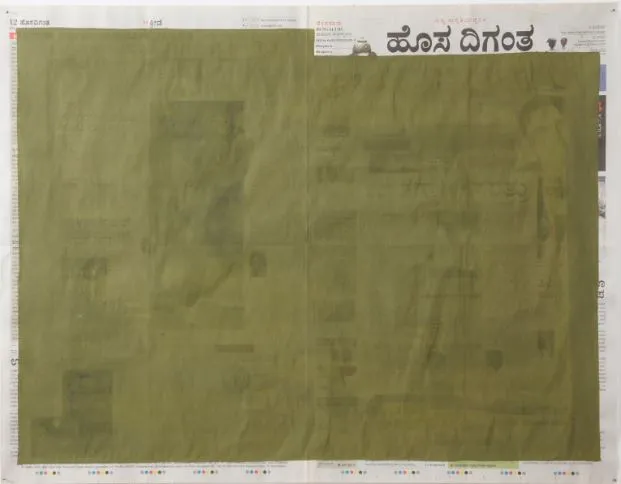
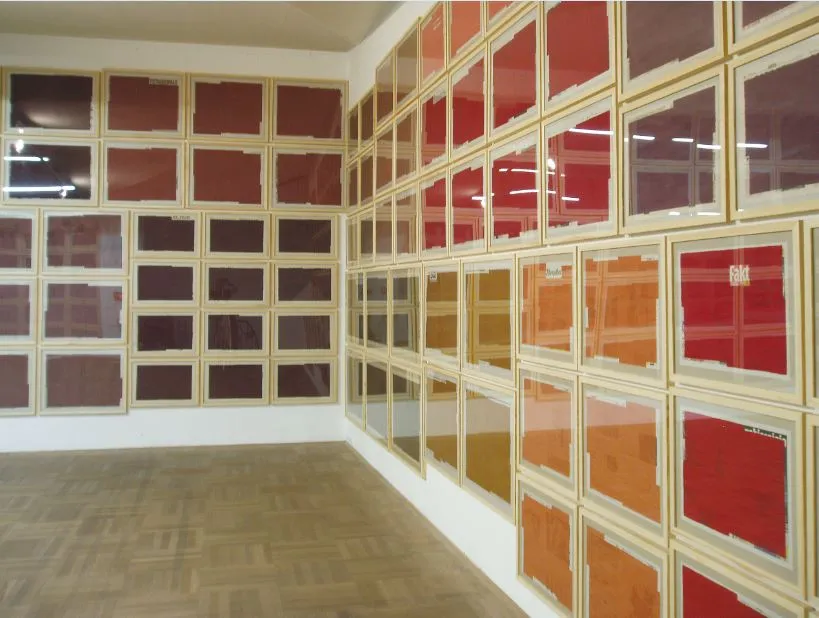
In the series Recycled News (2009), comprising hundreds of newspaper pages painstakingly painted over in watercolour, Kozłowski creates his new counter-device. Newspapers—understood as information devices—originating in different parts of the world were always treated in the same way, regardless of their language, place of publication or political orientation: subjected to an aesthetics of rhythms and repetitions and, above all, left equally unread. In painting entire pages of the displayed newspapers with multicoloured watercolours, Kozłowski not only questions their credibility but also makes visible the aestheticisation of media operations. Through this extraordinary accumulation of a multilingual press, with its message of the mass distribution of information, Kozłowski asks not only about the inflation of information and the media dispositif in general; he constructs a counter-device that serves neither to inform nor to recycle (however conceived), but to squander and disrupt the very idea of aesthetic politics and political aesthetics—the most perverse fusion of the pleasure principle and the information principle, the stage of political and aesthetic excitement that bursts into being every day on our television screens: the postmodern causa sui.
Devising Art
What, then, is Jarosław Kozłowski’s devising of art? What is his art, which practises politics not so much by annihilating itself as art, but rather by becoming an art that is a politics refraining from overt political intervention? What is it, if it exhausts its impulse neither in a politics of profanation—that is, restoring devices to common use—nor by becoming a politics of ungovernability, that is, refusing to use devices for the purpose imposed upon them (devised by official grammar)?

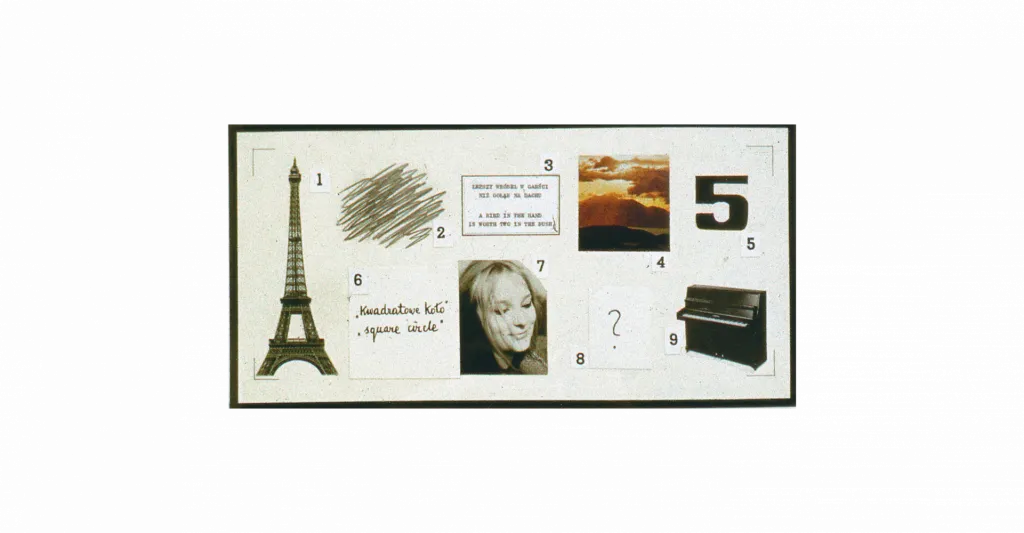
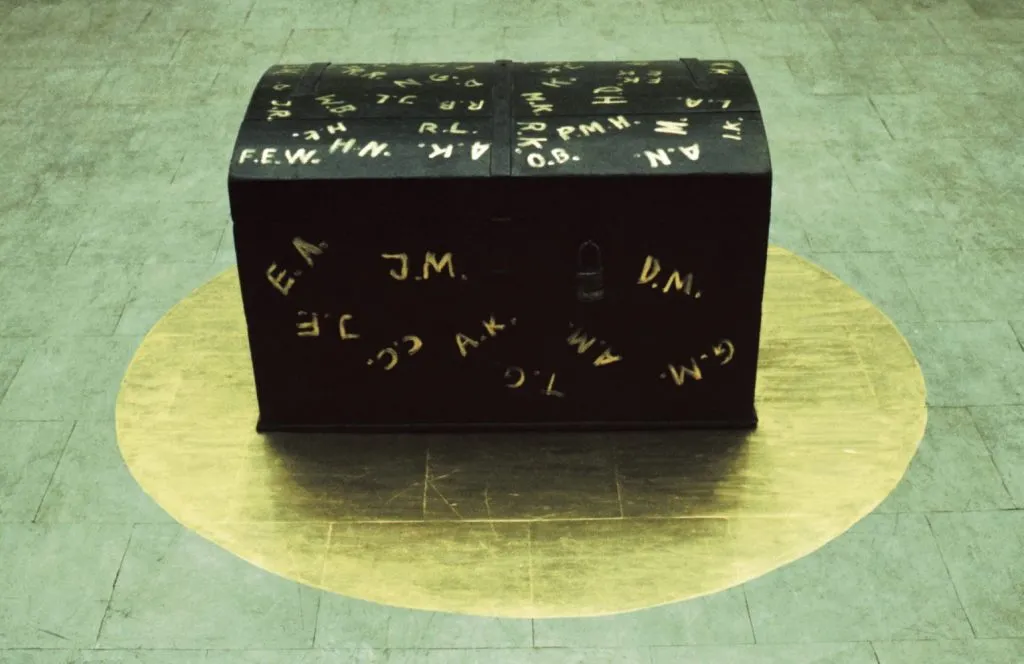
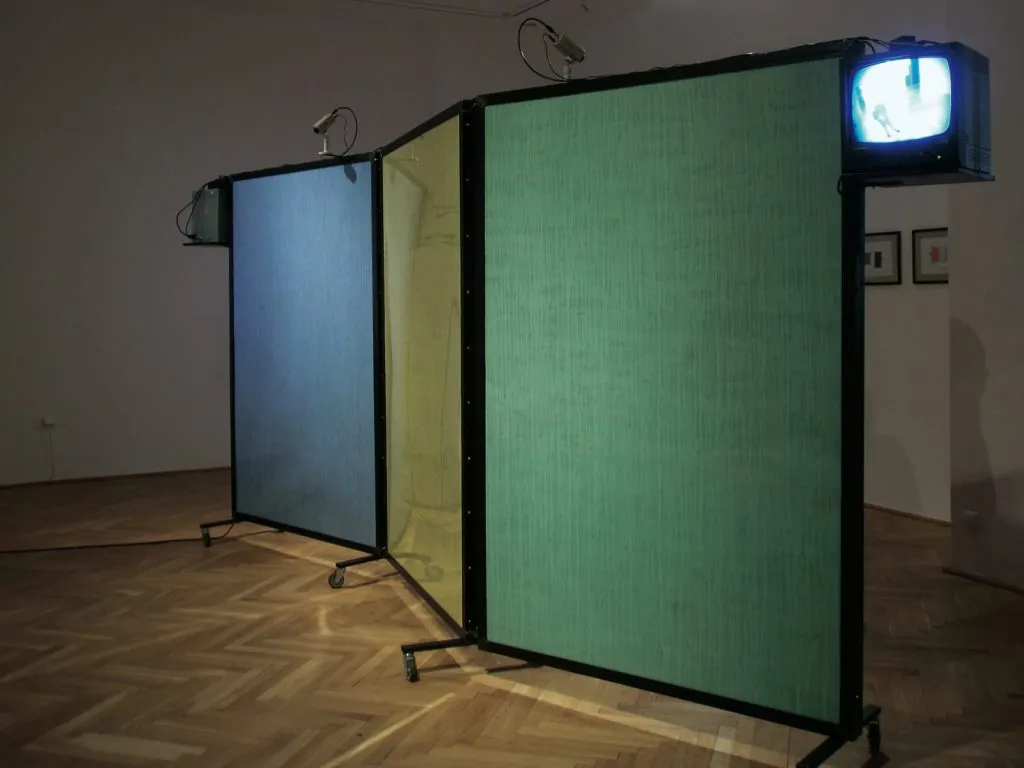
Kozłowski’s works have always been equipped with a counter-dispositive mode; they have always possessed the character of counter-devices, perversely combining into a whole a heterogeneous ensemble containing discourses, institutions, architectural forms, regulations, books, administrative provisions, scientific statements and philosophical, moral and philanthropic propositions. As provisional evidence, let us recall only a few: Lesson (1973) employs the drawing and text of a popular English-language textbook (a device), as well as a photograph based on a classroom drawing, to produce a counter-device. Facts (1976) employs a display case containing nine different representations that investigate the limits of similarity and dissimilarity between images. Exercises in Semiotics (1977) uses postcard photographs and a short text repeated in several languages—“This lovely red rose is a red rose” said John. Wall Painting I–III (1978–79) uses colour samples employed in painting rooms in the private flats of private tenants (citizens of the city). Green Wall, Its Image, Its Illusion and Its Likeness (1982) devises a wall, 2.5 metres high and painted green, upon which appeared the red inscription: “Zielona ściana poza określonym kontekstem (np. politycznym)”; this wall was reproduced at reduced dimensions upon further walls in other colours. Opus I (1983), in turn, makes use of enlarged X-rays of the author’s skull on photosensitive canvas (the device of the body and its organ). Opus II employs a crate with monograms and sounds emerging from it, while Still Life with Wind attempts to redeploy a small found drawing of a still life, reconstructed in the gallery space. In Screens (2009), the abducted device is the image itself (in the standard version, what is concealed is reflected in convex mirrors; in the “luxury” version, what the screen hides can be observed on monitors), while in Empathy, Kozłowski hijacks—somewhat riskily, I would say—the mirror neurons that, according to representatives of neurosciences, are responsible for empathetic emotions (Empathy of Chairman Mao for the Chinese People and vice versa, or Empathy of Mr Hitler for Mr Stalin and vice versa), before returning in Soft Safeguards: Russian Version (Moscow, 2010) to the theft of trivial objects: tables and chairs.
Perhaps, however, the greatest device Kozłowski has constructed—the greatest counter-dispositif—is the NET project, the network as an art of dialogue, in which the machine abducted by Kozłowski was, in a sense, the postal service: a communications network. Long before Bruno Latour and his actor-network theory, Jarosław Kozłowski and Andrzej Kostołowski, in a manifesto sent to 350 artists and art critics in Poland and around the world, encouraged collaboration and the free exchange of artistic facts22. The first presentation of NET, in Jarosław Kozłowski’s private flat in Poznań in 1972, was interrupted by the state Security Service; the second was organised that same year at the ZPAP club in Poznań. The network dispositif is the idea of creating a community that would be neither an anti-natural society nor a pre-political association, nor yet an organic city-state, but rather an assemblage or collective (the Polish literature uses two translations of the same term for the French collectif): an expanded community. By using the concept of the collective/assemblage, Kozłowski, Kostołowski and later Latour seek to emphasise the work of gathering everyone together: the more institutions, materials, procedures and techniques we associate with this concept, the more efficient and visible its work becomes. In a conversation with Bożena Czubak, this time about the origins and significance of the network—the art of dialogue—Jarosław Kozłowski says: “No, I was interested in operating in the field of art, not politics. I always guarded against the instrumentalisation of art, against transforming artistic practice into agitational activity in which criticality is lost. The network’s propositions challenged the political status quo, but the point was not to manifest opposition to the ruling regime spectacularly; it was, rather, to create an alternative, uncontrolled circulation of information and exchange of contacts, developed beyond the institutional supervision of any political system”23. It was, of course, about creating a counter-device that would completely reorder, in communicative terms, a poorly connected reality.
Spectacle or causa sui
Quoting the authority Régis Debray in The Future of the Image, Jacques Rancière argues that, by its very nature, the television image possesses no Other: it is the source of its own light, reveals itself to itself and is its own source; it “appears before our eyes as causa sui—Spinoza’s definition of God or substance”24. Images that refer to nothing beyond themselves become a spectacle. It now seems to me that Kozłowski’s entire effort is directed towards preventing images from becoming a spectacle.
Jarosław Kozłowski is insatiable in constructing counter-machines and hijacking (stealing) existing machines; Kozłowski becomes a kleptomaniac, abducting ever-new machines that he recognises as dangerous and unnecessary in our educated yet still badly connected world. The entire evolution of Kozłowski’s work (counter-engineering) consists not so much in freeing himself from artistic mythologies as in abducting ever more audacious machines. Everything Buzzes Except When It Gurgles. Exercises in Declension provides evidence of this advancing kleptomania and this increasingly developed logic of subversion. This time, the object abducted is no longer the press, books, a library, television screens or trivial objects from everyday life—tables, chairs, walls or flats. Nor is the abducted object even the postal service or the Internet, but language in its entirety, understood as a dispositif of thought and non-thought. Exercises in Declension is a premise (an attitude), an arrangement of exhibition, a form of visibility of the device of Poland.
Exercises in Declension is arranged in alphabetical order or in a scattered, free non-alphabetical order, and the vocabulary (universe) of this declension is limited to the devising of Polishness. It is the local dispositif of our Polish regional ontology. The sentence-images exhaust themselves in a monotonous declension of worn word-images—barbarzyńcy, bojkot, bolszewizm, Bóg, brzoza, chamy, demokracja, dewoci, duma, fałsz, godność, grubiaństwo, hańba, hitoria, honor, kłamstwo, komuchy, kondominium, krew, krzyż, mafia, magiel, masoni, mordercy, naród, nienawiść, obrzydliwość, ojczyzna, oszołomy, oszustwo, pachołki, patrioci, podłość, Polacy, Polska, poniżenie, prawda, prowokacja, pucz, Ruscy, sługusy, Solidarność, spisek, społeczeństwo, sprzedawczyki, szacunek, ścierwa, Targowica, tradycja, wiara, wierność, wojna, wolność, wstyd, wybuch, zaborcy, zabójstwo, zamach, zaprzaństwo, zboczeńcy, zbrodnia, zdrada, złodzieje, Żydki. This fusion of word-images conveys Polish madness, the dispositif of Polishness, which is simultaneously “an ensemble of heterogeneous elements”, “the very nature of their connection into a single whole—a network” and “a kind of strategic political formation”: Poland. Returning to Agamben’s analyses, Exercises in Declension has a threefold meaning: (1) juridical—a part of a judgement that produces a decision about Poles’ affective state, their depressive disorder; (2) technical—the way in which a mechanism is arranged: our language begins with the word “barbarzyńcy” and ends with “Żydki”, and is exhausted by sixty-four word-images; and (3) military—the totality of measures ordered for the pursuit of a certain politics of hatred and a psychotic politics based upon persecutory delusions and the logic of protecting one’s narcissism. I have no doubt that every territory (national dispositif)—America, Germany, the Netherlands, Russia, Argentina, Iran, Pakistan or Vietnam, and not only Poland—is served by a similar device in which we find a different fusion of word-images. I have no doubt that every territory (national dispositif) needs its own Jarosław Kozłowski to construct a counter-device upon another Fluxus stage.
Please understand me correctly: I am asking not only what Kozłowski’s devices are, but what Kozłowski himself is today—that is, how has he devised himself? Has he produced, for and against himself, his own counter-body, a counter-device opposing the device with the proper name “Jarosław Kozłowski”? Kozłowski now senses that image-words are essentially (1) operations rather than icons; (2) that their authority derives not from their being likenesses of things, but from their questioning the very dogma of resemblance; and (3) that there is a visibility which is not exhausted in images, but is contained in words—or, rather, in devices that form arrangements of words, things and institutions. For Kozłowski, visibility is created from a grouping of the world’s ontological situations, the grammatical possibilities of language and, finally, from the collision of a projected image with the blinded, corruptible eye. The image-word, as a result, is no longer the expression (ecstasy) of a thing or of that thing’s affect, but a set of operations by means of which arrangements of things—dispositifs—speak for themselves, operations whose action causes people to fall silent and go blind. The principal machine (device) of our world is the device of the world’s visibility and sayability itself. Kozłowski establishes something akin to a paradoxical syntax and a paradoxical telescope (a counter-device), in which sentence-images emerge: entanglements where icons are no longer what is visible and sentences are no longer what is sayable. Kozłowski’s devising of art becomes a stage once more, but neither a stage for the banality of politics nor a stage for the pleasure of aesthetics—that is, erotics—but a stage of defiguration, a space of conversion and translation where the relation between words and images becomes a theatrical (optical and linguistic) counter-machine, regenerating words that become images and images capable of speech. Speech, after all, is the management of visibility, while the image is the management of the possibility that a particular configuration of words may come into being. Kozłowski continues to seek his counter-machine.
1 Roland Barthes, Roland Barthes, Gdańsk 2011, p. 138.
2 Jacques Rancière, The Future of the Image, [in:] Aesthetics as Politics, Warszawa 2007, p. 93.
3Beyond Corrupted Eye. Galeria Akumulatory 2, 1972–1990, ed. Bożena Czubak and Jarosław Kozłowski, [catalogue of an exhibition at Zachęta Narodowa Galeria Sztuki], Warszawa 2012, p. 389.
4 See, inter alia: Michel de Certeau, The Practice of Everyday Life, Kraków 2008, p. 26.
5 Jarosław Kozłowski, Fluxus in a Nutshell, [in:] Fluxus Festival 2012, ed. Jarosław Kozłowski and Andżelika Jabłońska-Macowicz, Fundacja UAP, Poznań 2012.
6 Marcus Tullius Cicero, On the Orator, Kęty 2010.
7 Jacques Rancière, Aesthetics as Politics, op. cit., p. 24.
8 Ibid.
9 Bożena Czubak in conversation with Jarosław Kozłowski, [in:] Beyond Corrupted Eye. Galeria Akumulatory 2, 1972–1990, op. cit., pp. 10–12.
10 Michel Foucault, The Will to Knowledge, [in:] Michel Foucault, The History of Sexuality, Warszawa 1995, p. 93.
11 Michel Foucault, ‘Society Must Be Defended’. Lectures at the Collège de France, 1976, Warszawa 1998, p. 53.
12 See the excellent reconstructions in Magdalena Nowicka, ‘Urządze- nie’, ‘zastosowanie’, ‘układ’ – kategoria dispositif u Michela Foucaulta, jej tłumaczenia i ich implikacje dla postfoucaultowskich analiz władzy, [in:] “Przegląd Socjologii Jakościowej”, vol. VII, no. 2, 2011, http:// www.qualitativesociologyreview.org/PL/archive.pl.php [accessed 18 January 2014].
13 Giorgio Agamben, What Is an Apparatus?, [in:] Agamben. Przewodnik Krytyki Politycznej, Warszawa 2010, pp. 72–90.
14Michel Foucault’s Games, Michel Foucault in conversation with the editors of “Orinicar?”, [in:] “Kronos”, no. 3, 2010, pp. 198–223.
15 Ibid.
16 Ibid.
17 Giorgio Agamben, What Is an Apparatus?, op. cit., p. 96.
18 Bożena Czubak in conversation with Jarosław Kozłowski, [in:] Beyond Corrupted Eye. Galeria Akumulatory 2, 1972–1990, op. cit., p. 12.
19 Ibid.
20 Ibid.
21 Bruno Latour, Reassembling the Social: An Introduction to Actor-Network-Theory, Kraków 2010. 22NET—The Art of Dialogue, ed. Bożena Czubak and Jarosław Kozłowski, Fundacja Profile, Warszawa 2012.
23NET—The Art of Dialogue and Dissent. Bożena Czubak and Jarosław Kozłowski in conversation, [in:] NET—The Art of Dialogue, op. cit., p. 16.
24 Jacques Rancière, The Future of the Image, [in:] Aesthetics as Politics, op. cit., p. 44.
*Szymon Wróbel is Professor of Philosophy at the Institute of Philosophy and Sociology of the Polish Academy of Sciences and the Faculty of Artes Liberales at the University of Warsaw. He has published seven books and numerous articles in scholarly and non-scholarly journals. His latest book, entitled Deferring the Self, was published by Peter Lang in 2013.