
Globalising the Mundane
Jan Blommaert
Globalisation is driven by flows of people, goods, capital, images and discourses, the latter two being connected above all with tourism. It is in the tourism industry that we can observe what Arjun Appadurai called ideoscapes: images circulated throughout the world and the ideological frameworks used to interpret them1. We receive structured communications — brochures, websites and television programmes — presenting particular images of places and commentaries upon them. They invariably show “beautiful” places with lush, breathtaking natural settings; temples, cathedrals, palaces, castles and museums; shopping destinations and luxury hotels.
They are inhabited by extraordinary people in traditional dress presenting their native art, craft, dance and local cuisine to tourists — smiling and welcoming. And all this (here comes the ideological frame) is presented as typical and authentic. This is the desired image of those places, the globalised world as we know it — or would like to know it: a collection of unique and stunningly beautiful places where happiness may be enjoyed, and where calmly absorbing beauty will enhance our wellbeing. A journey to Beijing will therefore inevitably take us to Tiananmen Square, the Forbidden City, the Temple of Heaven, the Great Wall of China and the Olympic Stadium.
Bert Danckaert’s journey to Beijing resulted in an entirely different set of images: a series of ordinary walls, walls without significance, and walls that might come from anywhere — Mexico, Paris or Johannesburg as readily as Beijing. In his work we see a strangely familiar world of nondescript, unrefined places in which so much of our life unfolds; places we pass without paying attention; spaces that serve merely as trajectories, stretches connecting one place to another. In short, these are the places that define our lives and, in an urbanised world, the lives of many other people too. Walls provide the stage in Danckaert’s world. They bear the signs of human activity and human impact on urban space: the creation of dwellings and public facilities, rubbish and waste, and apparently disordered arrangements of objects that call purpose and design into question. Walls play a crucial role here, perhaps even constituting the only constant and visible elements. Danckaert’s work suggests that layers of human activity become especially visible in these strangely familiar geometric modules of late metropolitan modernism.
Bert Danckaert’s work prompts us to reflect on what is typical and authentic. As I mentioned earlier, the Beijing photographs might have been made anywhere. Only a few suggest that this is China rather than, say, France or Italy. In only some of Danckaert’s pictures do we see colours, shapes and characteristic features that our globalised ideological representations lead us to associate with “Chineseness”. Yet the subject of his work is clearly Beijing, and so the human habitats he photographs are first and foremost Chinese habitats.
For many reasons, therefore, they could not come from elsewhere: they must be from Beijing, and the photographs must tell us something about Beijing. Now compare them with Chinese restaurants in the Chinatowns of Europe and the United States. What we find there is very often the opposite of what we see in Danckaert’s photographs: an exaggerated “Chineseness” whose typicality and authenticity are proclaimed conspicuously to local customers. Reds and golds, images of dragons, griffins and phoenixes, a laughing Buddha here and there, Chinese inscriptions: everything is thoroughly saturated with “Chineseness”. This is usually combined with appropriate information in the local language to attract customers; the language spoken in the restaurant is also generally the local one rather than Mandarin or Cantonese. In this sense, Chinese restaurants cannot be Chinese; they must be local in London, Paris, Amsterdam, Rio de Janeiro or Cape Town.
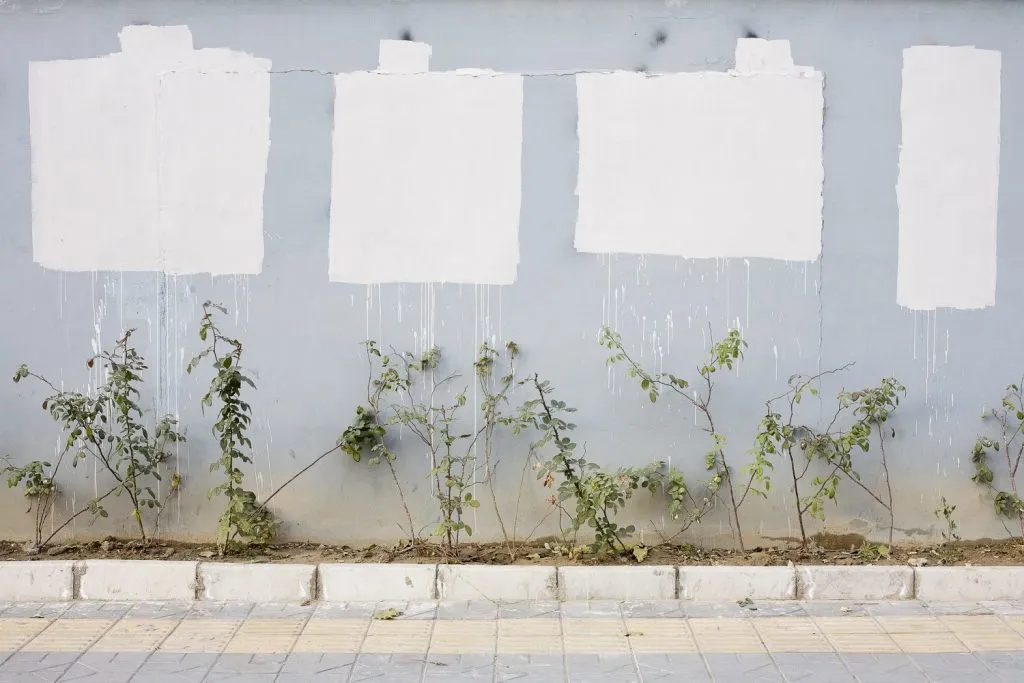
Here lies the strange dilemma Danckaert’s work asks us to consider: objects and spaces that look typical are generally typical only to outsiders, and entirely untypical from a local perspective. For most Beijing residents, the Forbidden City is probably less relevant than their workplace, neighbourhood or supermarket. The lives of those who live there are organised around ordinary places rather than tourist attractions. Conversely, for a tourist visiting Beijing, these locally important places will be far less interesting than the Forbidden City — because to the tourist the Forbidden City is typical, whereas a Chinese person’s workplace might remind them too much of home and therefore appear decidedly untypical. The tourist encounters the same unhistoried brick and concrete structures found at home — precisely those upon which Danckaert focuses. This dilemma, the reversal of typicality according to one’s point of view, lies at the heart of globalisation. It determines much of what we think we understand about the world and explains why, in this globalised world, we so often collide with different perspectives, priorities and meanings and have no option but to call them cultural or intercultural differences. At the heart of this lack of understanding lies the question of what is typical and authentic: simply the inescapable difference between members of a community and those outside it. Members create their own ordinariness and organise space as a place to live, not as a tourist attraction. Historically present attractions such as palaces, temples and castles arose despite, instead of, or in opposition to local habitats and their inhabitants. Outsiders are drawn to the extraordinary: the conspicuous difference between here and there. Such a contrast exists only for someone from outside and has very little significance for local people.

In Western scholarship, this problem of perspective is addressed by ethnography, the methodological branch of anthropology in which observers — outsiders by definition — attempt to come as close as possible to a local perspective, to the categories and methods used by members of a community in real life. Ethnography, as every textbook will tell us, is characterised by a clinical gaze that denaturalises objects and human activity for the observer, preventing them from appearing normal. It is precisely by refusing to take things for granted — in other words, by rejecting the possibility of treating one’s own perspective as the norm — that ethnography penetrates questions of culture and social organisation. The prerequisite is, of course, a refusal to accept the unfamiliar as extraordinary, the rejection of delight, shock or agitation in response to what is observed, and a strong determination to learn and understand. This recalls what ancient Greek philosophy called apatheia: freedom from passion as a path to true knowledge.
Ethnography does not rearrange the world of the community’s members or expect that world to change its order for the observer. It is concerned entirely with authentic normality and ordinary authenticity. Meanings must be learned; they cannot be imposed or implanted. Once they have been learned, the clinical gaze becomes a clinical narrative of normality in which strange “traditional” ways and forms of wisdom are presented “simply” as the life of a person or group, as someone else’s way of making sense of and ordering everyday life. Ethnographic accounts are stories of an ordinary person in everyday life, where things that are in some degree extraordinary — rituals, conflicts and moments of spectacle — are treated simply as parts of the everyday order.
This is precisely what Bert Danckaert has done. His lens is a clinical, ethnographic instrument of observation and narration. His work shows authenticity and typicality seen from within, from the perspective of a community’s members. This may be jarring for those raised amid the commercialised imagery of global tourism, but it is inescapable. Danckaert’s work offers a shortcut to lived experience, a leap into a Beijing that is real and authentic as the home of millions of people. It helped us survive the flood of typical images and information produced by Beijing’s Olympic year — images perhaps more typical for us, the tourists, than for them, the Chinese. It is worth seeing the typical, nondescript Beijing and recognising that the way we perceive it is an important aspect of globalisation. This is the moment when we come to know the Other, when we are able to step beyond commercialised typicality and authenticity and begin to understand life as it is, visible in the organisation of space as a place of habitation rather than one filled with tourist attractions. Danckaert’s work thus becomes a calling card for intercultural understanding. It succeeds in moving beyond an easy, conventionally exotic imagery and leading us back to where everything begins and ends: real human life. In an age of globalisation, this level of understanding is a genuine and valuable form of knowledge.
Polish translation by Agata Mendrychowska
- Arjun Appadurai, Modernity at Large: Cultural Dimensions of Globalization, University of Minnesota Press, Minneapolis, 1996.