
•
Janusz K. Głowacki
An artist is only someone who can turn a solution
into a riddle
Karl Kraus1
Writing about the architect Louis I. Kahn, Roberto Salvadori considers him the most philosophical mind among architects, the most complex and enigmatic designer of the second half of the twentieth century. He writes: “As a great humanist […], he did not hesitate to present his vision of the world and indicate starting points for aesthetic reflection. The basis of this reflection is form. An ideal, a priori entity, something akin to the Platonic eidos. Purely mental, like Leonardo’s painting. Something spiritual and immeasurable, something that ‘precedes the drawing’. The drawing, moreover, is what realises form, transforming its ‘spiritual being into a tangible presence’”2. This is an attitude rare and, to a degree, isolated today. As I read Salvadori, images of the great Renaissance painters immediately appeared before my eyes: Bellini, Michelangelo and Raphael, but also our contemporary Stanisław Fijałkowski3. Thirty years ago, when we spoke for a text I was writing, he described his attitude in these terms: “Art is also a particular practice of metaphysics, a distinctive form of philosophising. In today’s world, which has lost its religious sensibility, that sensitivity to the spiritual world, or ‘metaphysical feeling’, as Witkacy used to call it, art provides certain experiences that were once provided by religion”4. He believed “that in the face of the continuing pressure of mass culture, one must develop the capacity for concentration within oneself; one’s attitude must be internalised. He described his activity as a secular equivalent of theology”5. In a selection from his notes published in 2002, Fijałkowski writes: “Every blank canvas breathes a different space and contains in embryo its own light; it vibrates to a rhythm peculiar to itself and is charged with powers that the painter may reveal and make meaningful”6. He develops this thought further, writing about the significance of the frame in a painting: “Enclosing a painting causes an indeterminate plane to become individualised. […] Slowly, we ourselves also begin to identify with the painting—the top is the head, the bottom the feet, and the left and right sides represent our hands. If we added two points to such a plane, they would become a face, our alter ego. […] From then on, whatever else appears on it will already be a dialogue with Someone Mysterious who is before us or within us. And thus […] we enter the spiritual world, and everything we do will be speaking or listening, which seems to me still more important than speaking”7. In Fijałkowski’s approach, the mixing of colours acquires a dimension quite different from that of purely technological procedures. The artist writes: “Any colour, for that matter, tempered by a small addition of its complement, looks interesting—more interesting than a pure colour—because one senses within it a tension between opposites. It is therefore not separated from the other colours that differ from it, but foretells them within itself. Here it seems appropriate to recall the Chinese Yang-Yin symbol expressing the antagonism and balance of the forces of the universe. The mutual interpenetration of day and night, light and darkness, pan-cosmic sexuality, life and death, the positive (white) and negative (black) element, is also a suggestive demonstration of the presence within each of its opposite”8. Fijałkowski’s attitude thus appears as yet another exceptional phenomenon in today’s world, though not an entirely isolated one, for it has its intellectual affinities even if they are not a matter of common awareness. The artist’s works, meanwhile, are among the most mysterious works in contemporary art.
In his works Fijałkowski does not illustrate particular philosophical propositions or worldviews. As he said thirty years ago, painting is a way of practising philosophy. It compels one to reach deeply into oneself, to free oneself from stereotypes and from the paralysing immediacy of the surrounding world. Paintings in particular—non-representational, yet paradoxically impossible to classify as abstract paintings. Constructed from forms, rhythms, colours, contrasts and values, they do not obey what are by now the classic rules for constructing a picture from such elements, rules so eagerly displayed by whole generations descending from Impressionism. In his paintings, every form, every colour, every value and contrast has its own separate provenance; each is an entity in itself and contains specific meanings. To decipher them, we must reach deep into the strata of our subconscious, where the circle, the triangle… and even colour have their own encoded meanings. Verbalising them is difficult—it is as though we wanted to recount what we see with the so-called third eye. Yet this, too, contains the meaning of making art: communication at a non-verbal level. An important element that often facilitates this non-verbal understanding is—banal though it may sound in this context—the composition of the whole, where the top and bottom of the painting and its right and left sides, as mentioned above, have their own significance, and where mutual compositional tensions are not merely tensions in a purely visual sense, but arise from tensions in the—so to speak—conceptual meanings they contain. Here lies the mystery9. It is from these that Fijałkowski constructs his paintings, not merely from organic or geometric forms juxtaposed according to one normative aesthetic or another. This is why the paintings resist attempts at classification so strongly. Apparently abstract, but in fact full of meanings and senses, they compel us to think and activate the imagination, as though somehow contradicting their apparent abstraction. Yet they are abstract paintings in the sense that they reach towards abstract entities in the philosophical rather than the visual meaning of the term.
They are difficult to decipher, although among them are works whose message is very clear. Consider the print—by nature more concise in its form—entitled Ladder of Humility from 1981. In a vertical rectangle is a suggestive drawing of a ladder, whose left vertical support is inscribed anima and its right corpus. Through the rungs at the bottom we see an indeterminate form marked “OSB”; by the upper edge is a simplified drawing of a “sun” with a black dot inside—the Eye of Providence (?)… Another version of this work is entitled St Benedict’s Ladder. It would take an exceptional mastery of words to attempt to verbalise the meanings present in these works. In more than thirty years of knowing the Professor, I never really asked Him to interpret his works. A professional’s error, or perhaps rather an egocentric concern to preserve my private contact with his paintings. Zbigniew Herbert wrote beautifully and aptly about what eludes our minds, what we can only find in our subconscious, invoking a surviving fragment of a verse inscription and the example of the palace at Knossos:
“The ruin of the poem nevertheless shines with a convincing radiance:
…………………………………….. ……………………..noble ………
remember when you are old
……………………our youth
…………………….we were……
……………………..beautiful after all…
…………………many…………………..
……………….now as you depart
Evans [when rebuilding the palace at Knossos—J.K.G.] filled in the missing spaces with words, a multitude of his own words. A ponderous commentary that trampled the vision”10. I am always afraid that words, even the most apt, might “trample the vision”, whether visual, musical or, in the broadest sense, artistic. For we must remember that Stanisław Fijałkowski’s visual statements are not truths that he reveals to us in a final and indisputable manner. His works are an impulse that sets our mental and sensory personality in motion, not revealed truths. In the conversation already cited, the artist maintained: “To see the world in boundary situations, when two entirely different things, two different meanings, two ideas exist simultaneously—and to be able to investigate their interconnections—is to find oneself in the most creatively inspiring territory. […] I do not seek unambiguity in art, because I have noticed that all things left unsaid, ambiguous situations, intersecting contexts, and even the undoubted perversity of the inexplicability of certain existing phenomena, are far richer”11.
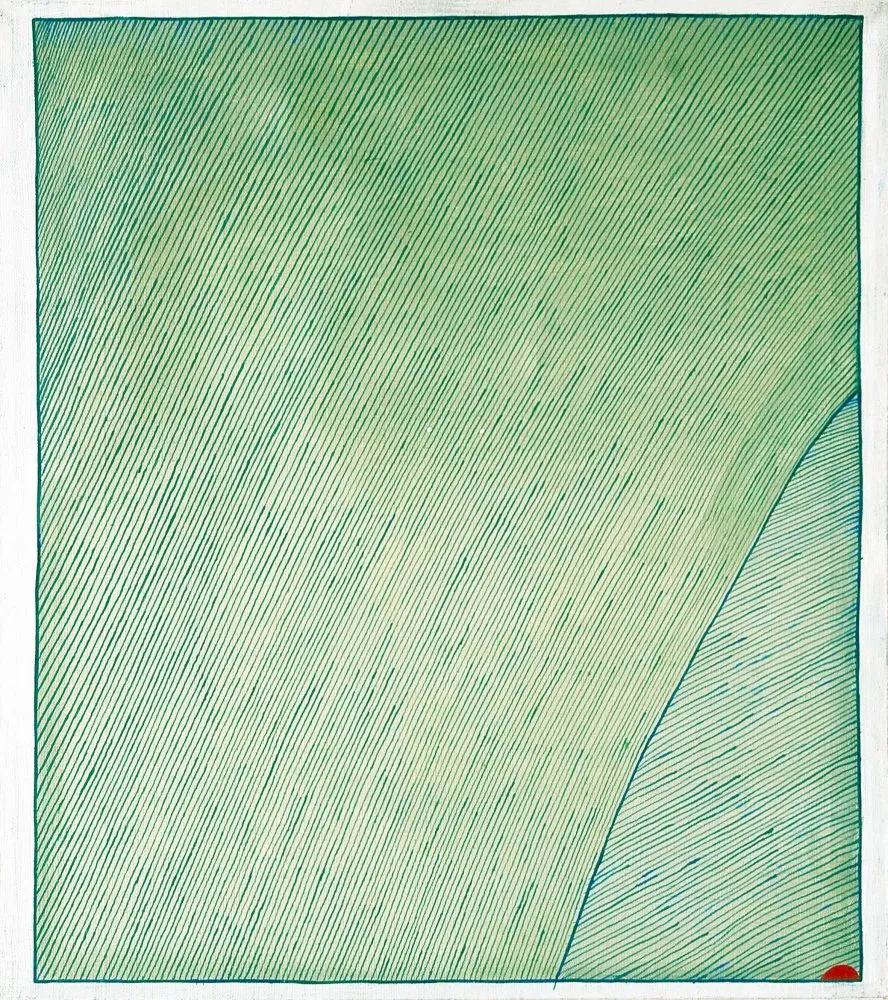
Many years ago, while hanging paintings for his solo exhibition at Galeria 86 in Łódź12, we began discussing one of them, a small work bearing only the date: 11 May 87. It turned out to be a painting of his Wife. The Professor also revealed that he considered it one of the most lyrical paintings he had made up to that point. How is one to interpret this small painting, whose active field is delineated by the hand-drawn line of a frame at the edge of the canvas, its interior filled by an apparently uniform field of colour covered in narrow, horizontal brushstrokes? An apparently empty painting that comes alive only in daylight, turning it into one of the truly most lyrical painterly compositions. I believe the element of daylight—the only light in which Fijałkowski paints—has a justification that does not derive solely from painterly tradition. For me, the participation of this external factor in bringing the painting into being has a philosophical justification. But what is lyricism? Fijałkowski offers no answer to that. There are, moreover, several series of paintings entitled For Waleria, his wife. Who would dare to penetrate the couple’s personal relationship? Nevertheless, the paintings are highly suggestive, even though we cannot fully decipher their personal, authorial cause. The fact is that these paintings began to appear in the later period of the artist’s work, when he increasingly rarely gave his works titles. They become ever more mysterious to the viewer, while for Fijałkowski, I believe, painting becomes an increasingly private and intimate matter. Earlier, his titles suggested trails to follow. The works and the anecdotes associated with them are widely known: the almost emblematic The Beautiful Truth-Teller of 1973; the earlier I Am Awakening Your Conscience, Professor and I Am Withdrawing, Professor, both from 1968; and the series Talmudic Studies and Black Sashes.
His best-known cycle of paintings, something of an authorial signature, is the Motorways series begun in the early 1970s. As one may surmise, these are not the actual motorways of the contemporary world. As a modern word of our civilisation, the motorway replaces biblical vocabulary; “in this conception, it is a modern symbol of Jacob’s Ladder, on which, as we know, Angels ascended into heaven and descended to earth. […] Formally, it is characterised by constructing the painting along a diagonal, with a dynamic movement upwards”13. Even this explanation by the artist does not exhaust what has been painted. Like the titles in the past, the author’s concise commentary merely offers a trail towards one’s own communication with the painting. In connection with the Motorways, another painting comes to mind in which, according to my interpretation, there are as many as two motorways… I shall not attempt a literary interpretation. I merely wish to indicate points on which thought might fasten. It is the painting This Man Comes from Basra, made in 1974. It contains two motorways running towards two peaks, between which appears an irregular, roughly triangular form with its apex pointing downwards. This detail, like every element of a Fijałkowski painting, seems highly significant. In this quasi-triangular form are two openings (?)—eyes (?)—“If we added two points to such a plane, they would become a face”14…
And that Basra in the title. Which Basra? There are two cities of that name in the Middle East. One is the Syrian Basra (Bosra), known for its Roman and medieval monuments. I do not think, however, that this was what prompted the painting. The other Basra is a city in Iraq. Both played significant roles in Islamic culture. Basra in Syria was an important point on the pilgrimage route to Mecca, while Iraqi Basra, Al-Basra, is today forgotten but was, from the seventh to the ninth century, a highly important centre of independent Islamic thought. One of the most distinguished poets, Abu Nuwas, worked there. His innovative poetry, at odds with the orthodox interpretation of the Quran, could develop there precisely because Basra was the birthplace of Mu’tazilism, a school of thought founded on the teachings of another famous native of Basra, the theologian Hasan al-Basri, whom his contemporaries regarded as a great moral authority. Against the advocates of predestination, he defended the existence of free will. Later, too, one of the principal Mu’tazilite theologians, Al-Jāhiz, worked there: a political and religious polemicist, prose writer and scholar who wrote on theology, philosophy, literature, biology, history and even psychology. I do not intend to recount these undoubtedly interesting strands here; I merely wish to draw attention to where Stanisław Fijałkowski’s motorways may lead.
Writing about the almost magical effect of Stanisław Fijałkowski’s art, I cannot omit a painting that marked an important stage in my understanding of modern art. It was at the end of the 1960s. In “Poezja”, I believe, I saw a black-and-white reproduction of the painting The Sudden Appearance of Beatrice. Only several years later did I see the original. I do not wish to recount here the many-stranded story that might have its source in this painting, confronted—as the clear trail in its title naturally suggests—with Dante’s Divine Comedy. Those interested in a literary reflection on the entire series of Sudden Appearances of Beatrice should consult Agata Ławniczak’s excellent essay The Communion of Saints in “Tygodnik Powszechny”15. I wish only to emphasise the role of form. Reduced to a black-and-white graphic version, it exerted so powerful an effect that it lodged deep within my mind. This experience clearly confirms what Salvadori, quoted at the outset, wrote about Kahn: the primacy of form in the work of art. Years ago I reported Fijałkowski’s views on this matter in the following terms: “In the visual arts, the principal operation is with meaningful form of an archetypal, open character, so as simultaneously to suggest the direction of the viewer’s activity through its connection with forms already present in their subconscious and conscious mind, and to make it possible to open in another direction—for forms not yet conscious to awaken and constitute themselves. This is why Fijałkowski employs extraordinarily precise form. The works he creates are preceded by studies, sketches and finally a drawing of the form, so that it may function effectively in a painting or print. On many occasions, the print plays an intermediate role between studies and a painting; it is a test of form”16. The search for form is an attempt to give a spiritual entity a “tangible” existence. Because its nature is spiritual, its “tangible” form—only occasionally brushing against what is familiar—remains a mystery. This is an extraordinary task requiring exceptional mental and sensory sensitivity and precision. “Only such precision of form attests to true spirituality and mastery”17. This mystery of giving a “tangible” existence—whether in a drawing, print, painting or any object of art—is, I believe, the condition for a genuine work of art to come into being.
I shall permit myself to conclude these reflections on just some of the keys to Stanisław Fijałkowski’s “riddles” with one more quotation from the Notebook18: “Only a few bow with respect before the mystery contained in the object we have imbued with spirit, which is a suitably painted canvas. Let us join them; let us not be so captivated by ourselves, and, turning our heads away from the clamour of the marketplace, let us enter the realm of blessed silence—let us be still!”
*Janusz K. Głowacki, art historian, critic and co-founder of Galeria 86.
November 2009–January 2010
1. Quoted after R. Salvadori, The Double Life of Louis I. Kahn, in “Zeszyty Literackie”, no. 3, 2009, p. 109.
2. Ibid., pp. 108–109.
3. When discussing Stanisław Fijałkowski’s work, it is difficult to divide his practice into painting and printmaking; when I speak generally of painting, I therefore mean the entirety of his oeuvre. I shall return to this question below.
4. J. Głowacki, Graphic Alphabets, in “Odgłosy”, no. 45, 1979, p. 12.
5. Ibid.
6. S. Fijałkowski, Years of Learning and the Workshop, Łódź, 2002, p. 53.
7. S. Fijałkowski, op. cit., p. 54.
8. Ibid., p. 55.
9. Stanisław Fijałkowski writes about compositional principles and meanings in his Notebook. It is difficult to reproduce extensive passages here, including those entitled Around the Frame from March 2007. The Professor kindly made some of these notes available, for which I offer my heartfelt thanks—J.K.G.
10. Z. Herbert, Crete: From the Unpublished Writings, in “Zeszyty Literackie”, no. 4, 1999, p. 53.
11. J. Głowacki, op. cit.
12. S. Fijałkowski, Paintings, Galeria 86, May 1988, cat.
13. S. Fijałkowski, Years of Learning and the Workshop, op. cit., p. 60.
14. See note 7.
15. A. Ławniczak, The Communion of Saints, in “Tygodnik Powszechny”, 2003, https://www.tygodnikpowszechny.pl/swietych-obcowanie-122486
16. J. Głowacki, op. cit.
17. S. Fijałkowski, Notebook, 30 March 2007; see note 9.
18. Ibid., 1 April 2007.