
…
Agata Mendrychowska
Samuel Szczekacz’s painting, a Unist composition from 1938, bears the comment ‘after W. Strzemiński’1. It was made when Szczekacz was twenty-one and had been Władysław Strzemiński’s pupil for more than two years.
The first conversation about studying painting with Strzemiński was reportedly held at the Astoria café at 27 Piotrkowska Street in Łódź, where the contemporary artistic bohemia, primarily from the Jewish community, used to meet. Szczekacz had just passed his school-leaving examination, while the only painting school in Łódź belonged to Wacław Dobrowolski, who did not admit Jews. Mojżesz Broderson, a friend of Strzemiński, arranged the meeting with the future teacher for Szczekacz and three other candidates wishing to begin painting studies2. In the words of one participant in the meeting at the Astoria, Pinkus Szwarc, it proceeded as follows: ‘[Strzemiński] received us very warmly, but said: “I do not have a school for painters, I do not know where I could teach you, I must think. Call me in two or three weeks.” And so we did. And he came back with a proposal that it would be an unofficial school…’3.
Lessons were held in the premises of Public Vocational Continuation School No. 10, which Strzemiński directed. He taught by a method he would employ ten years later with painting students at the State Higher School of Visual Arts in Łódź. ‘The condition for raising the level of art, developing and perfecting it, is complete mastery of every preceding tendency. Each successive tendency is either a development of those that came before, or an opposing supplement to their shortcomings. Each tendency results from contact with the history of preceding painting. Modern art can be created only by someone who has learnt everything that came before and everything that exists today – and who has retained the freedom of a critical position towards it all’4.

In accordance with Strzemiński’s premises, Szczekacz created Cubist, Neoplasticist, Cubo-Unist and Unist compositions in quick succession5.
The point of departure, however, was Cubism, which according to Strzemiński is ‘a threshold through which every visual artist should pass; it is an objective school of form based on strict laws of construction’6. Certain Cubist compositions from 1936 and 1937 appear to develop illustrations concerning the construction of a Cubist picture: ‘the independence of colour from line (before 1918)’ or ‘the dependence of colour on line (after 1918)’, included in Strzemiński’s Unism in Painting7. Szczekacz’s sketches containing Cubist studies dated 1936 have survived. Yet the task of using a compass to draw an analytical study of a head differs markedly from the anatomical study of a skull made two years earlier, a drawing of a death mask, a plaster cast of a hand, a drawing of a Mickiewicz sculpture, or portraits of a young model sketched during courses in Maurycy Trębacz’s studio8.
The artist’s gouaches dated 1936 are his interpretations of Malevich’s Suprematist compositions9. A later architectural composition by Szczekacz, known from a photograph, calls architectons to mind.
As Pinkus Szwarc recalled: ‘Strzemiński was fascinated by Kazimir Malevich and had brought a dozen or so of his drawings from Russia, which he showed and explained to us. At that time [in 1936] he himself made a Suprematist Lithograph in Homage to Malevich. We, meanwhile, printed the first book about Malevich, which was easy because we received a ready-made black-and-white plate’10.
Szczekacz and Strzemiński’s other ‘private’ pupils also attended an evening printmaking course at the school. They learnt to make their first lithographs there (with the assistance of a printer) and attended lectures on lettering given by Stefan Wegner. As Pinkus Szwarc related: ‘It was a cover so that we could use the school. And that was why we also learnt lithography, which was part of the official curriculum. Because it was not an art school. Lithography was needed for learning how to print. Functional printing’11.
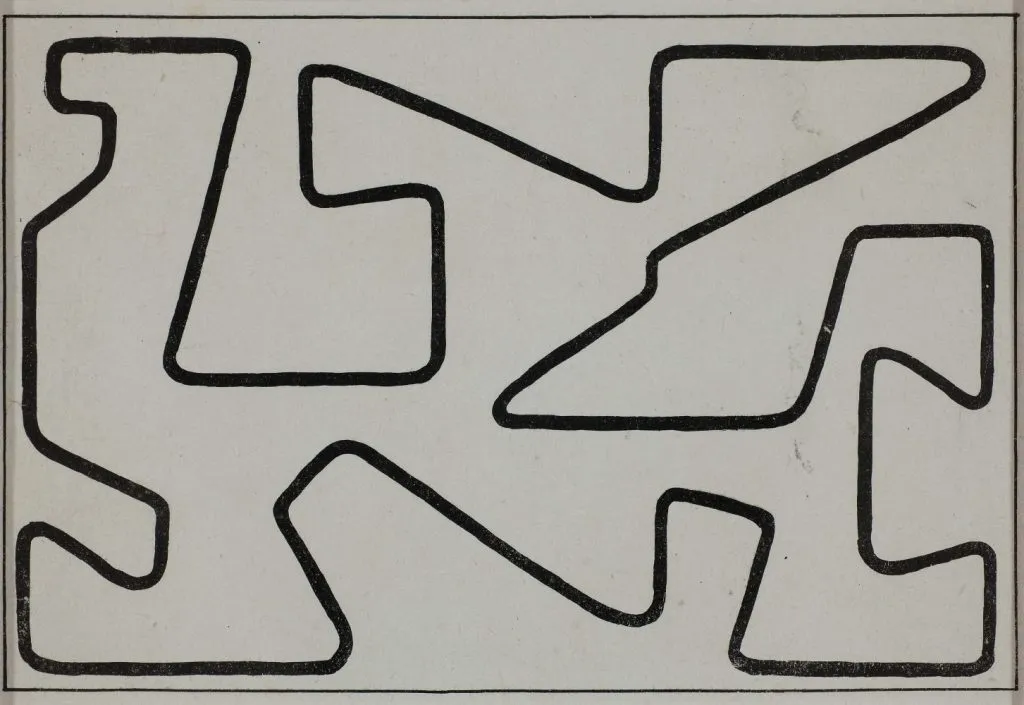
It was in the school printing shop that Motorem słów12, with graphic design by Szczekacz, was printed in 1938. Thanks to the skills he acquired at the school, the artist also created a portfolio of lithographs consisting of black-and-white and colour compositions on paper coated on one side, which he entitled Teka malarska [Painting Portfolio].
The artist designed the layout of the portfolio’s first title page according to Władysław Strzemiński’s principles of functional printing. The graphic division of the text was intended to follow ‘the rhythm of the reading eye’13. On the cover, the artist placed the text ‘samuel szczekacz, teka malarska, łódź 1938’. It was set in lower case, in a layout in which the artist used different typefaces and font sizes to indicate the significance of particular fragments.
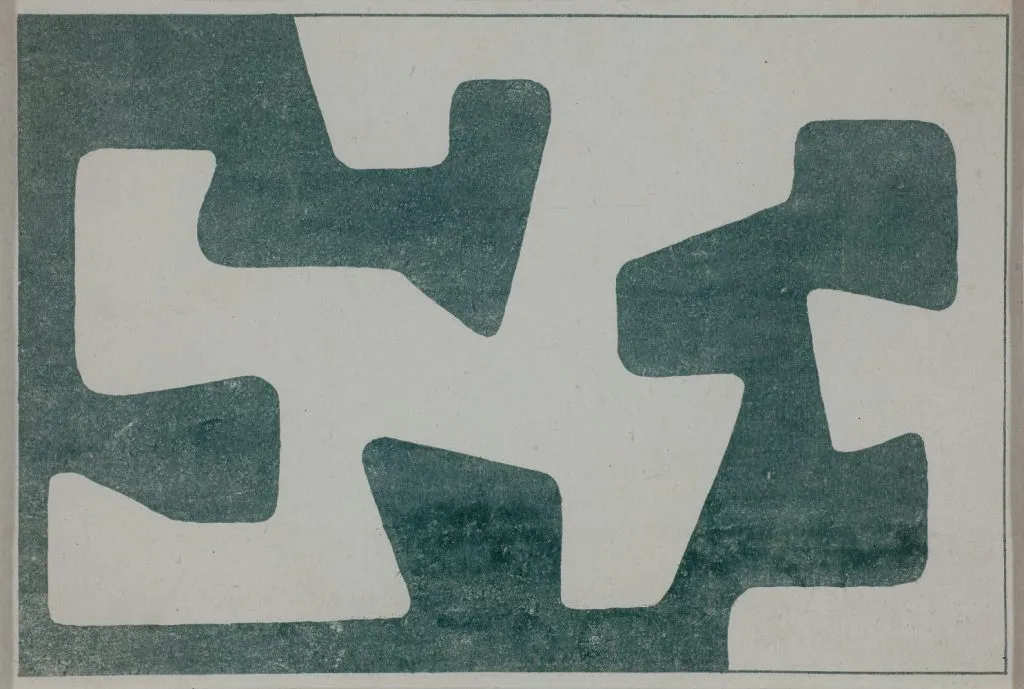
In the upper left corner of the title page of Teka malarska, the artist placed one of what are now his best-known compositions, which he was already using as his own graphic mark, superimposing his name and surname on it. The artist also chose this same Unist composition, accompanied by his own commentary, for the final issue of the journal Forma14. It was produced in several colour variants: blue, grey-and-black and sepia15.
The artist constructs the composition from the type of similarly shaped lower-case letters: a, o, m, n, r. The dense arrangement of letters is contained by the thin line of a square frame. ‘The unity of a picture cannot be achieved through a system that opposes shapes and colours to one another as dynamic signs. Compositional unity can be achieved only by composing parallel and co-ordinate visual elements organically connected with the flat surface of the picture and its boundaries’16, he writes in the article in Forma beside which a reproduction of this composition painted in tempera was published. It served as the model for lithographs that, for technical reasons, are its mirror image. The composition may be one example of the application of Wegner’s lectures on lettering. ‘The assembly of printed matter follows a thorough analysis of the letter, the determination of its dimensions, proportions and shape, and an understanding of its basic components’17, Wegner wrote, calling for ‘letters to be restored to the dignity of the components of art’18. As he maintained: ‘The letter is not merely a conventional sign; it is a component of form, a coloured shape containing potential visual values’19. Szczekacz is inspired by printing material: ‘type and paper in place of paints’20. He uses the mechanical method of typewriting in constructing Construction, a gouache from around 1937. The letters M, O and i, together with punctuation marks, are impressed on paper in a uniform rhythm and begin to exist as shapes devoid of meaning, filling the composition’s rectangular planes.
The exhibition at the Łódź IPS in January 1939 was the artist’s final presentation in Poland. In previous years, Szczekacz had exhibited primarily painting. The catalogues also record ‘Neoplastic sculptures’, a ‘Łódź photogram’ and architectural designs (in the graphics and drawing section).
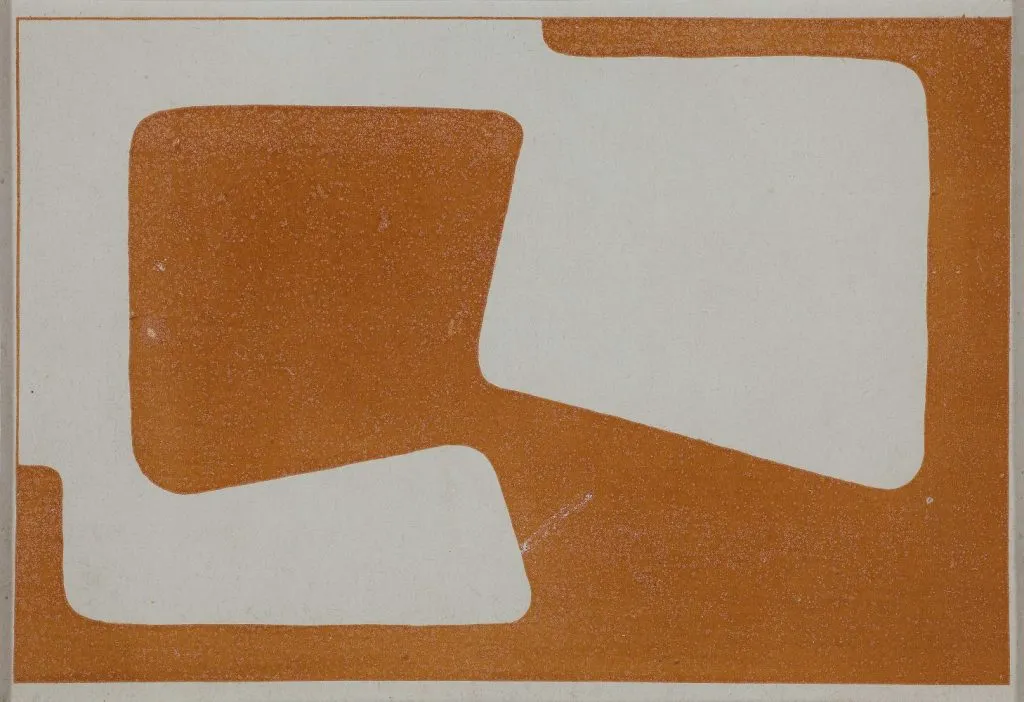
Photographic documentation of the exhibition indicates that it included sixteen lithographs from Teka malarska. The sheets, close to A4 format, on which the lithographs were mounted were not framed but slipped behind a transparent cover, making the entire collection appear as a uniform whole21. Presented in this arrangement together with the title page, the lithographs form a rhythm of compositions in vertical and horizontal format (11 × 16 cm) or square format (16 × 16 cm). The Neoplastic compositions are characterised by the use of the golden ratio; the Cubist compositions by the dynamism and contrast of line, plane and colour; and the Unist compositions are constructed from organic forms, gentle lines and interpenetrating planes. The works also include an intermediate Neoplastic-Cubist composition and the aforementioned Unist composition formed from letter shapes.
From the surviving lithographs in different colour variants, one may conclude that several copies of Teka malarska were made, which the artist used as his portfolio. Before leaving Łódź, he was also said to have given one version to the Municipal Museum of History and Art, which housed the International Collection of Modern Art established at Strzemiński’s initiative. Years later, Szczekacz wrote from Paris to his sister: ‘There was an exhibition here of Polish art from Łódź at the Pompidou Museum, and I had a surprise because they exhibited nine of my pictures that I had left at the Łódź museum before the war’22.
Szczekacz sent one of the portfolios of lithographs to Basel, to the typographer Jan Tschichold. He was presumably given the address by Strzemiński, who corresponded with Tschichold and organised an exhibition featuring him in 1932. He also edited one of Tschichold’s publications, issued in Łódź in 1938 under the title Druk nowoczesny23.
A letter has survived – Tschichold’s reply – written to ‘Scekacz Szmuel’ at the address of the Hebrew University in Jerusalem in late May 193924. The author of The New Typography praises the works, writing that they made a ‘pleasant impression’ on him. He also writes that he had had an opportunity to meet Hans Arp and show him the portfolio he had received.
Hans [Jean] Arp, together with his wife Sophie Taeuber-Arp, was then associated with the Cercle et Carré and Abstraction-Création groups in Paris, with which artists from Strzemiński’s circle and the ‘a.r.’ group collaborated. In Łódź, Szczekacz may have seen one of Arp’s works, a relief with biomorphic forms, in the International Collection of Modern Art.
The letter indicates that Tschichold intended to send Szczekacz a newly published book of poems by Arp, with typography of his own design. This points to Muscheln und Schirme, printed on Japanese paper and issued in a small edition with illustrations by Sophie Taeuber-Arp.
Arp wished to receive the ‘portfolio’ so that his wife, who edited the abstract-art journal Plastique, could publish reproductions of Szczekacz’s works in it.
It is not known whether the artist sent Teka malarska to Arp’s address as provided in the letter. Plastique continued to be published until 1939. The war broke out not long after the letter was written, and Taeuber-Arp and Arp emigrated to Switzerland.
When leaving Poland, Szczekacz took with him the collection of lithographs; the paintings he most likely presented in his first solo exhibition at the Student Organization of the Hebrew University in Jerusalem in 1940; a copy of Motorem słów with his own graphic design, for which he designed a colour cover after his departure. He also took from Łódź, among other things, commemorative photographs of Strzemiński and Kobro with their daughter, the curriculum of the school’s graphics group, catalogues of exhibitions in which he had participated, an issue of Forma, the Kazimir Malevich album, Stefan Wegner’s Zasady kompozycji drukarskiej, Druk funkcjonalny and Strzemiński’s Unizm w malarstwie25.
Agata Mendrychowska, art historian and editor of Wojciech Wilczyk’s book Niewinne oko nie istnieje and exhibition catalogues. Curator at Atlas Sztuki.
1. It repeats a lost composition by Władysław Strzemiński reproduced in issue no. 6 of Forma in 1938. Unlike Szczekacz’s work, however, Strzemiński’s picture was a relief. Cf. J. Ładnowska, Samuel Szczekacz/Samuel Zur – uczeń – kontynuator – artysta, [in:] Sztuka w Łodzi 2, SHS, Łódź 2003, p. 234.
2. Ratowało mnie malarstwo…, Anna Kuligowska-Korzeniewska’s interview with Pinkus Szwarc [Pinchas Shaar], set designer at the Jewish Theatre in the Łódź ghetto, [in:] Łódzkie sceny żydowskie. Studia i materiały, Łódź 2000, p. 129. The following, who already knew one another from the same scouting troop, were to become Strzemiński’s pupils: Samuel Szczekacz, Pinkus Szwarc and Julian Lewin. Juda [Yehuda] Tarmu also studied with them for a short time.
3. Ibid., p. 130.
4. W. Strzemiński, Sztuka nowoczesna a szkoły artystyczne, [in:] Pisma, Wrocław 1975, p. 163.
5. Titles of Szczekacz’s works in exhibition catalogues between 1937 and 1939.
6. W. Strzemiński, Muzeum, [in:] Pisma, op. cit., p. 279.
7. W. Strzemiński, Unizm w malarstwie, Łódź 1993.
8. J. Ładnowska, op. cit., p. 231.
9. Cf. A. Turowski, Malewicz w Warszawie. Rekonstrukcje i symulacje, Kraków 2002, pp. 318–319.
10. Ratowało mnie malarstwo…, op. cit., p. 130. Cf. Kazimierz Malewicz 1875–1935 [album of lithographs and photographs. The lithographs after works by K. Malevich were made by pupils of Public Vocational Continuation School No. 10 in Łódź. One lithograph by Władysław Strzemiński was added], Łódź [1936], 29 × 29 cm, 26 original lithographs, 10 photographs of Malevich’s architectons, 1 portrait, white paper, single-colour black lithographs + 1 colour lithograph, [in:] Władysław Strzemiński 1893–1952 w setną rocznicę urodzin, Muzeum Sztuki, Łódź 1993, p. 212, item 4.A.42.
11. Ratowało mnie malarstwo…, op. cit., p. 130.
12. A volume of poems by Leon Grabowski, Motorem słów, design by Samuel Szczekacz, printed by Zygmunt Matuszewski, Łódź 1938, 21 × 15 cm, 16 pp., 4 unnumbered pages, white paper, one-colour black print. Cf. Druk funkcjonalny, Muzeum Sztuki, Łódź 1975, p. 58.
13. A. Turowski, W kręgu Strzemińskiego, Warsaw 1973, p. 23.
14. Cf. S. Szczekacz, Forma 1938, no. 6, p. 25.
15. Other colour versions of the Unist composition from Muzeum Sztuki in Łódź are held in the collection of Galerie Berinson in Berlin as Typographic Studies. A tempera painting with the same composition also existed.
16. Cf. Forma, 1938, no. 6, p. 25.
17. S. Wegner, Zasady kompozycji drukarskiej, [in:] Druk funkcjonalny, op. cit., p. 46.
18. Ibid.
19. Ibid.
20. W. Strzemiński, Druk funkcjonalny, [in:] Pisma, op. cit., p. 166.
21. Cf. Samuel Szczekacz 1917–1983, Galerie Berinson, Berlin 2009, p. 12.
22. J. Ładnowska, op. cit., p. 240. This refers to what was then the largest presentation of Polish art abroad, Présences polonaises. L’art vivant autour du Musée de Lodz at the Centre Georges Pompidou in 1983, which included Szczekacz’s lithographs.
23. An abridgement of Jan Tschichold’s Typographische Gestaltung, Basel 1935. Cf. J. Zagrodzki, Drukarstwo nowoczesne w kręgu Władysława Strzemińskiego, [in:] Druk funkcjonalny, op. cit., p. 31.
24. Letter dated 29 May 1939. Cf. Samuel Szczekacz 1917–1983, op. cit., p. 34.
25. According to a letter from S. Zur to J. Ładnowska (dated 8 August 1966). Cf. J. Ładnowska, op. cit., p. 239.